The Nikon Z9, Z8, Z6, Z7, and Zf cameras have dual gain ISO – this means it’s better to shoot at ISO 500 than at ISO 250, due to the wider dynamic range and less noise. This is a guest post by Dariusz Breś (Instagram | Facebook | Flickr | Previous posts):
The Nikon Z9, like most modern cameras, uses Dual Gain ISO technology. While different systems use different names (eg, Dual Native ISO or Dual Conversion Gain), the principle remains the same.
This means the sensor doesn’t operate linearly across its entire sensitivity range. Instead, it has two separate data readout circuits:
- Lower Gain (ISO 64 – 400): Optimized for maximum dynamic range (amount of detail in highlights and shadows).
- Higher Gain (ISO 500 and above): Optimized to minimize read noise.
What the hell does that mean?
The Nikon Z9 switches to the higher gain stage (second circuit) precisely at ISO 500. At this point, there is a sharp drop in read noise, making the image at ISO 500 paradoxically “cleaner” and offering higher tonal dynamics than at ISO 400.
So, if you’re running low on light – for example, in a sports hall or on a cloudy day – instead of sticking to intermediate values (such as ISO 320 or 400), it’s better to immediately jump to ISO 500. This will give you better image quality.
ISO 64 – The Gold Standard
This is the most important value for the Z9. Unlike many other cameras, which have a base ISO of 100, the Z9 goes down to ISO 64. This provides the highest possible dynamic range and the lowest noise. Landscape and portrait photography in the studio or in full sunlight is ideal. Stick to this value whenever conditions allow.
ISO 500 – Dual Gain
An ISO 500 image in the shadows may look cleaner than at ISO 400, and the noise level will be very similar to that at ISO 200-250, even though the gain is theoretically greater.
Upper limit of utility
The Z9 performs very well at high registers:
- ISO 800-3200: The image is still professional-quality, almost lossless after light processing.
- ISO 6400-12800: Noise in shadows becomes visible, but thanks to the high resolution (45 MP), after resizing the image to a smaller format or using AI noise reduction (eg, in Lightroom), the photos are fully publishable.
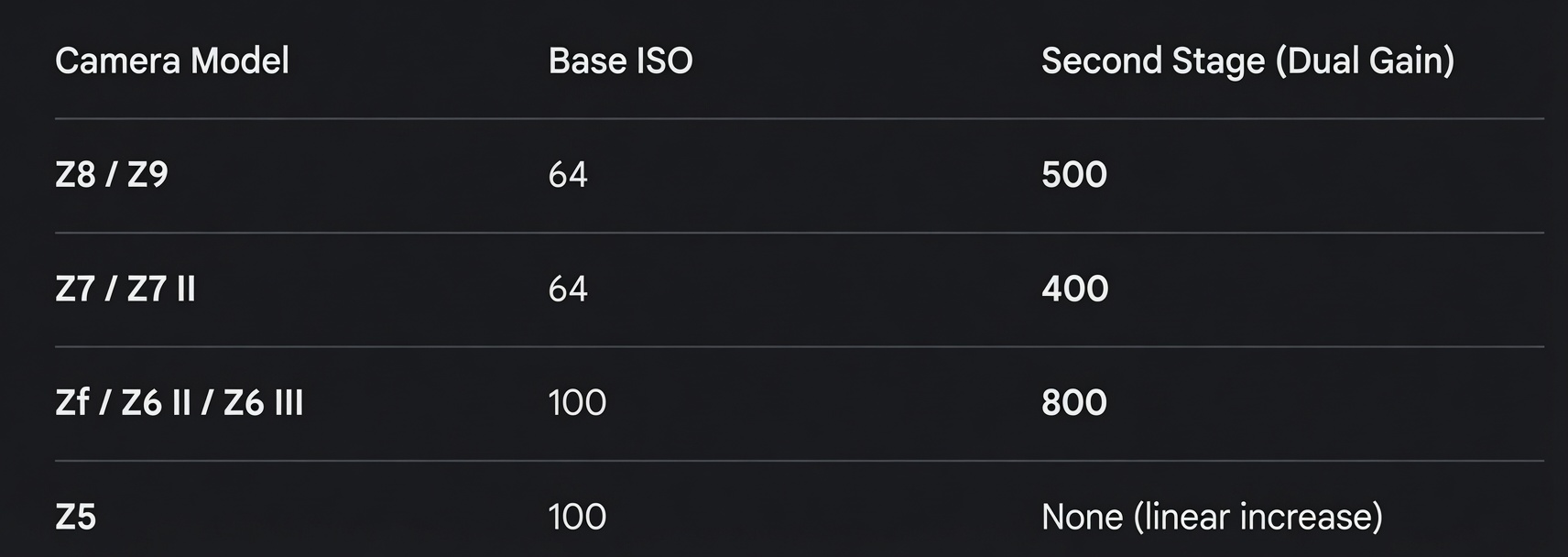
What does it look like in other Z cameras?
Movie
In movie mode, the sensor operates nonlinearly, and its sensitivity thresholds differ from those in the N-Log and RAW profiles (except for SDR, which uses the same thresholds as photo). This is due to the nature of logarithmic profiles, which intentionally shift the dynamic range to preserve detail in highlights. As a result, the camera uses two separate data readout circuits:
- Lower Gain (ISO 800-3200): Optimized for maximum dynamic range. ISO 800 is the “first base”—it produces the cleanest signal and the most detail in highlights (equivalent to ISO 64 in photos).
- Higher Gain (ISO 4000 and above): Optimized to minimize read noise in difficult conditions.
What does this mean in the movie?
The Z9 and Z8 switch to higher gain precisely at ISO 4000. At this value, there’s a dramatic drop in shadow noise. Paradoxically, an image at ISO 4000 will be significantly “cleaner” than at ISO 3200.
Application?
If you’re shooting at night or in dark interiors and you’re short on light at ISO 2000 or 2500, don’t be afraid to go higher. It’s better to jump straight to ISO 4000 rather than sticking with intermediate values, which generate the most electronic noise (so-called “grainy” blacks).
If you’re shooting “on vacation” in the Standard profile, stick to ISO 64 during the day and jump to ISO 500 at night. However, if you enable N-Log for professional color grading, your new “zero” becomes ISO 800, and your night mode is ISO 4000.
Two bases for a filmmaker:
- ISO 800: The gold standard. The best dynamic range, ideal for working with ND filters during the day.
- ISO 4000: Low light mode. Best image clarity when you need to shoot in the dark.
Why is this important?
Most of us have learned for years that “The higher the ISO, the worse the image.” This was true in the era of DSLRs before Dual Gain technology. Someone might see a value of 4000 on the screen and think, “Oh my, that’s a lot, I’ll have nothing but dots in the image.”
Meanwhile, in the Z9/Z8, an image at ISO 4000 will look better, cleaner, and more professional than at ISO 3200 because the sensor “rests” on this new, more efficient circuit.
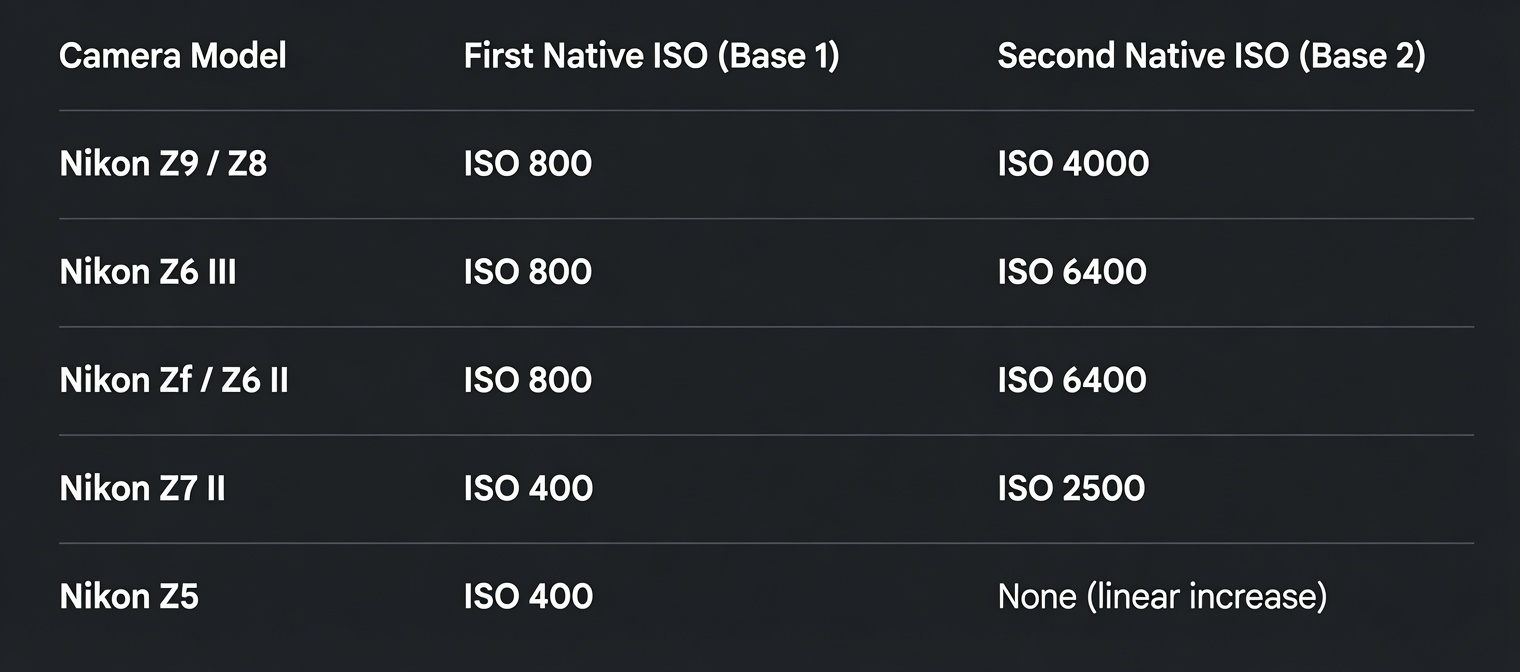
What does it look like in other Z cameras?
This article was originally published here.
If you have an interesting idea for a guest post, contact me here.
Previous guest posts by Dariusz Breś:
Using the new Sigma 200mm f/2 DG OS Sports lens on Nikon cameras with the Megadap Pro+ adapter
Sigma 300-600mm f/4 DG OS Sports lens for Sony E-mount tested on the Nikon Z9 camera
The new Sigma 500mm f/5.6 DG DN OS Sports lens tested on the Nikon Z9 camera
Plena vs. Art (Nikkor Z 135mm f/1.8 S Plena vs. Sigma 135mm f/1.8 DG HSM Art)