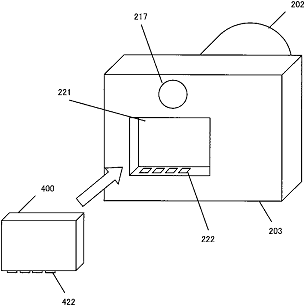
Nikon filed a patent in Japan for interchangeable sensor solution in mirrorless cameras. According to the patent application, the interchangeable sensors will have different AF system, speed (fps) and pixel count in order to suite different shooting preferences:
| AF | Rate | Image quality | Remarks |
|---|---|---|---|
| Contrast AF | Slow | Good | All pixels and therefore can be used for image output quality |
| Phase difference AF (center point, etc.) | Fast | Normal | AF phase is very small because the pixel is used, less quality degradation |
| Phase difference AF (sensors, etc. Cross) | Fast | Bad | AF phase for a number of pixels used, interpolation is required and can lead to lower quality |
Just few weeks ago Nikon filed another patent for an interchangeable sensor with more connection details:

Recently Olympus filed a patent for a modular DSLR camera.
Nikon patent details:
- Patent Publication: 2010-283651
- Release date: December 16th, 2010
- Filing date: May 6th, 2009
Juts a reminder that not all patent applications get implemented in real cameras.

Related posts:
- It’s a Nikon patents Friday (Nikon mirrorless, interchangeable lens camera)
- Nikon mirrorless interchangeable lens camera
- First mockups of Nikon’s mirrorless interchangeable lens camera
- Patent application reveals new drawings of a Nikon mirrorless interchangeable lens camera
- More Nikon patents – hint for a mirrorless Nikon camera?

34 Comments
First, yay!
This looks interesting. As far as a full understanding of what it means for us im a little in the dark. When it comes to looking at these copyrights i get a little lost to be honest.
I would like to be able to pull out a sensor for a new one.+) I mean who does not?
It means areas on the sensor will be used for focusing — just like the Fuji sensor. Don’t know how smart messing with the image quality is. Guess the engineers at Nikon know what they are doing.
Have you seen images from that Fuji? It’s image quality is GARBAGE, probably the worst compact available today.
I don’t quite see the point. The sensor is only part of the camera body of course, and on an EVIL will be cheaper than on a DSLR.
But on most bodies the sensor is pretty closely matched to the other electronics. The CPU has to have enough power to crunch the data coming off the sensor.
So imagine that you have a dedicated HD 1080i sensor that you slot in. OK so its resolution is precisely matched to the resolution of the video. But you can’t record HD video at 1080i without a CPU capable of delivering serious computing welly.
There might be an argument for swapping a 12MP sensor for a 24MP or maybe options related to the anti-aliasing filter. But 24MP is going to be pushing the limit for what is practical with small sensor size.
The only one I can see that would really interest me would be the likelihood that an IR sensor would appear in any drop-in scheme like this. Might be an argument for a B&W filter as well, but seems a stretch.
This one’s gonna make Thom Hogan happy
lol. Not until they produce it. He’s going to put on his website “Two years since Nikon has ignored MY idea of sensor modularity. Japanese people are never ones to listen to ME, lord knows I’ve tried to get them to hire ME to consult for them!”
I hope it doesn’t Byt Hom
BOO! BOO! Bad pun. C’mon, surely you could have tried harder than that.
I guess at some point you gotta ask yourself if you’re out there to assemble cameras or shoot stuff.
There’s lenses, batteries, memory cards, flashes, gels, tripods, etc… I’d imagine those sensors will be costly as well as even more delicate then lenses. Not sure how I feel about this.
welcome to lego land!
Now THIS should make Ken Rockwell happy! Legoland always does.. lol!!
meh he will say its to complicated and will provide tutorial on how to photoshop heads
I still see his sons face in my nightmares
Oh no! Please don’t mention the photoshopped head again!
I’ve shown it to so many people at my work and laughed so hard about the ugly photoshop job that i don’t think I can take anymore of this…
OMG! How can he give readers photoshop tips in his reviews and dare show the same people this kind of result???
It’s a good thing he doesn’t allow comments on his site…
(sorry, Ken, I’m a little harsh, but come on, let’s be honest here: that’s an awful PS job)
Now if they’d only offer a way to upgrade those existing dslr’s with a new sensor instead of having to get rid of it to upgrade, I’d be happy for my old D2 not to be quite as fast as it used to be so I could have better resolution but not have to ditch a perfectly good body because I won’t ever use it when I have a D3 to choose from. I’m sure there is much more involved than I know but it was nice with film bodies because even if it didn’t perform the latest and greatest compared to newer bodies, you still kept it around when you didn’t need all the new technology.
If it’s going to somehow translate to less cost, I’m all for it. But ask yourself, would you want the old D1H interface on your D3s? This might entice more folks to update, but at some point, you need to totally upgrade.
Honestly, is this camera ever going to come out? Nikon has paralysis by analysis.
I do not see how it would cost less? If a camera offers greater flexibility and upgrade options then it will likely cost a little more upfront. You may save later if a sensor comes out that you want and you upgrade the sensor as opposed to buying a whole new camera.
I think this is a great idea for some cameras.
Mark
And what you just described would contribute to less cost.
The real boon here would be being able to swap between a low-light priority sensor and a high dynamic range sensor.
It might or might not be produced. But it will never catch on.
This is one of the ideas that sound great in theory but nobody really needs.
Like APS
Like nobody needs a Hasselblad or Mamiya?
It will make cleaning the sensor easier.
Yes, especially when you clean it with sand-paper.
^most likely it will have some optical glass to protect it.
And everybody will whine how bad their pics are because of it…
They should make native 1920×1080 sensor with huge pixels.
Dito!
How very RED of Nikon. Cleaning the camera body will be a lot easier now…
Does anybody ever stop to think that Nikon ACTUALLY wants to patent this sensor swopping idea, simply because it Allows Nikon to swop the sensors for ‘their own convenience’, using the same camera body design with minor teaking on buffer and firmware?? Just like they did on the D3 and the D3x. Thus, maximizing profit.
Its not designed for customers to choose which sensor/s they wish to buy, and install it on the body by themselves. Neither is it an OPTION for you to buy a D4 body in 2011 and just request Nikon service centre to upgrade it to D4x sensor for “x” amount in 2012.
and yes, I know its for their mirrorless camera. Not DSLR. but still that the general route they may be thinking.
So don’t jump for joy YET.
youre laughing now but in years to come people will mention ken rockwell in the same breath as ansel adams, the man is a true visionary.
Well … Order me 4 sensors, please !!!
1 for color-photo (high-res)
1 for ir-photo (high-res)
1 for color-video (low-res)
1 for ir-video (low-res)
At least Nikon is the first company to admit that AF on sensor = worse IQ. Anyway you slice it, no mirror = sucks balls.
Fuji didnt mention that in the press material for their compact which uses this approach, and it’s buyers are in for a nasty surprise …..
Roger, Nikon is talking about phase AF on the main sensor. I see “constrast AF quality: good” on that table.
Ricoh GXR system…