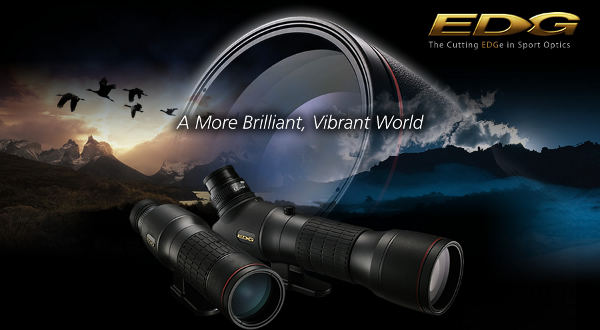
New Nikon EDG Fieldscopes with DSLR compatibility

Update: B&H is now taking pre-orders on those new Nikon Fieldscopes – expensive!

Nikon continues to release DSLR compatible products. Few weeks ago we had the new Nikon Fabre Photo EX – a portable stereoscopic microscope that can be attached to a Nikon DSLR camera and now we have some new fieldscopes that can be attached to a DSLR or a Coolpix. I just don’t like the red ring on the front of those fieldscopes :)

For more info – visit the Nikon EDG website:
edg nikon optics New Nikon EDG Fieldscopes with DSLR compatibility
RRP: TBC
Sales start date: Summer 2009   

Nikon is pleased to announce its new flagship range of cutting-edge premium, yet affordable, new EDG fieldscopes that offer first-class performance out in the field.

The new EDG 85/85-A and EDG 65/65-A models incorporate legendary Nikon technology that provide users with unparalleled optical and mechanical performance. Nikon’s ED (Extra-low Dispersion) ensures chromatic aberration compensation and the phase correction coated roof prism provides high resolution for sharper, clearer viewing. Straight models, in addition, feature dielectric high-reflectivity multi-layer prism coatings for higher contrast than ever.

The compact, stylish design is waterproof thanks to the O-ring seals and nitrogen gas which ensure clear observation even under adverse weather conditions making the scopes ideal for a range of activities that include bird watching and nature observation.

Seven new compatible eyepieces have also been introduced making it possible to use the fieldscopes in a variety of applications under various climatic conditions. The newly developed zoom eyepiece especially makes for superior optical performance with minimised distortion and comfortably long eye relief (18.4-16.5mm).

• ED glass for chromatic aberration compensation
• Phase correction coated roof prism for high resolution
• Dielectric high-reflective multilayer prism coating on roof prism for the brightest view (straight only)
• Full multi-layer coating
• Bayonet mount with lock for eyepiece lens
• Waterproof up to 2m for 10 min., and fog-free – thanks to O-rings and nitrogen gas (main body and eyepiece joint is water-resistant)
• New and stylish design
• Three tripod mount screw holes provided for flexible mounting position
• Combination of Nikon D-SLR camera, Digital Camera Zoom Attachment FSA-L2 and EDG Fieldscope enables super-telephoto photography or digiscoping.

Key features – Eyepiece

• Seven kinds of new eyepieces for optimum optical performance
• Bayonet mount with lock for easy attachment and release
• Fully multi-layer coated
• Waterproof up to 2m for 10 min., and fog-free – thanks to O-rings and nitrogen gas (body and eyepiece joint water-resistant)
• Eyecup moves in and out at turn of eyepiece ring and stops at any of three positions with click useful for observation and digiscoping (except for FEP-30, FEP-25LER and FEP-20-60)
• FEP-30W features interchangeable soft rubber eyecup for observation and digiscoping eyecup for connection with digital camera bracket FSB series
• FEP-25LER has ultra long 32.3mm eye relief
• FEP-20-60: Long eye relief (18.4-16.5mm) Minimized distortion with aspherical lens
• Current Fieldscope eyepieces can be used with FS Eyepiece Mount Adapter EMA-1
• Many compact digital COOLPIX series can be attached to eyepiece of FEP series (except FEP-20-60) with digital camera bracket FSB series


Related posts:

  1. Nikon Introduces new fieldscope DSLR camera attachment FSA-L2
  2. Apple did not include Nikon D90 in their Digital Camera RAW Compatibility Update
  3. Does a ‘modular DSLR’ make any sense
  4. Underwater housing for Nikon DSLR
  5. Nikon DSLR with a 800mm lens used as an accelerometer

This entry was posted in Other Nikon stuff. Bookmark the permalink. Both comments and trackbacks are currently closed.

28 Comments

  1. Justin
    Posted March 17, 2009 at 10:30 am | Permalink

    I looked on the provided Nikon site, and can’t figure out what length in 35mm format terms these are comparable to. Can someone please enlighten me?

  2. Neil
    Posted March 17, 2009 at 10:47 am | Permalink

    Now we’re talking. Bird photographers like me may start using these.

  3. Posted March 17, 2009 at 11:02 am | Permalink

    how would this be different from using a normal telephoto lens?
    it seems to be manual focus, and doesn’t seem too bright.

    • Gary L
      Posted March 17, 2009 at 11:10 am | Permalink

      The 1st models will be for stuffed birds only, but future models, will offer optional features for live critters, perhaps larger birds like turkeys for starters, then working their way down the food chain ……… 8?).

    • Neil
      Posted March 17, 2009 at 12:23 pm | Permalink

      It’s like using a telescope instead of a telephoto. You get far more magnification but you do pay for it with light. Like anything else, it’s a compromise. And those of us who take bird pictures know that you can never get close enough.

      • Justin C
        Posted March 17, 2009 at 3:25 pm | Permalink

        So then the F-Stop is going to be a very high number? I wonder if the camera will be able to meter?

        • Neil
          Posted March 18, 2009 at 7:03 am | Permalink

          Depends on the camera. A D200 and higher can.

  4. Char
    Posted March 17, 2009 at 11:50 am | Permalink

    Uhmmm… where does it say that you can mount a DSLR camera to that thing? I can only find a mentioning that you can mount Coolpix cameras….

  5. Posted March 17, 2009 at 3:11 pm | Permalink

    I wonder what the pricetag will be on these. Nikon fieldscopes do not come cheap

  6. Crabby
    Posted March 17, 2009 at 4:03 pm | Permalink

    Two comments:

    1. I once owned the last mirror lens Nikon made, a 500mm model. It, unlike earlier Nikkor mirror lenses, had a red line in the same place as do these scopes. This marking could just be cosmetic or have some meaning in Nikon-speak.

    2. I saw a couple of sample photos made with an SLR or DSLR through an earlier Nikon fieldscope. By the usual standards, I was not impressed. Has anyone seen a photo using the new ones?

  7. DNHJR
    Posted March 17, 2009 at 5:31 pm | Permalink

    No VR?

  8. Anonymous
    Posted March 17, 2009 at 6:22 pm | Permalink

    Whats with the red ring? It reminds me of Canon’s L series lenses as that red ring seems to symbolize…

    • MB
      Posted March 17, 2009 at 7:48 pm | Permalink

      Yes it is the ring, and it is red too, it seams to me that the red ring is symbolizing readiness of the lens to produce great images, or more likely it just resembles the red stripe on Nikon DSLR cameras.

  9. Ernst
    Posted March 17, 2009 at 6:43 pm | Permalink

    Nikon offers an F-mount adapter for their current fieldscopes as well.

    Notwithstanding the tiny apertures (think f/11 – f/13), the digiscoping results I’ve seen simply aren’t very sharp. These really aren’t good alternatives to telephoto lenses.

    That said, somebody on one of the birding forums rigged up a system using a Nikon DSLR and a physically larger astronomical telescope that retailed for only a little more than the Nikon fieldscopes (about $2K, I think) with *spectacular* results. The pictures looked as good as those taken with a 600mm f/4 (though I think the effective focal length was more like twice that). The only downside was that tiny aperture.

  10. Dan
    Posted March 17, 2009 at 8:01 pm | Permalink

    B+H has preliminary pricing up on these, and it’s very high ($2700 – $3200). The only consolation is that all Nikon sport optics (binoculars and spotting scopes) have ridiculous list prices and sell for maybe half of their list price. B+H may have posted list prices, rather than what they’ll sell for when they become available (although they’re accepting orders at those prices). If the prices are real, Nikon has priced the new ED-G scopes above every other scope on the market except Leica (they’re above Zeiss).

  11. Ben
    Posted March 17, 2009 at 9:08 pm | Permalink

    I have a pair of nikon binoculars that I use for sporting events and I have to admit, they are very crisp, but that being said I don’t think that my eyes have the same resolving power of my D300. I will probably stick with my 70-200 unless these fieldscopes are less than $500.

  12. lblaod
    Posted March 18, 2009 at 12:08 am | Permalink

    cool

  13. Mikko
    Posted March 18, 2009 at 3:56 am | Permalink

    “Nikon is pleased to announce its new flagship range of cutting-edge premium, yet affordable, new EDG fieldscopes that offer first-class performance out in the field.”

    3299$ yet affordable?

    • den
      Posted March 18, 2009 at 7:54 am | Permalink

      have you checked other prices? you will see products within that range are all around 3000€. up to my knowledge there is no lens capable of delivering around 2000mm for nikon mount (if used with a dx camera, or araound 1500 for use on FX)

  14. Mikko
    Posted March 18, 2009 at 10:38 am | Permalink

    Ok, I didn’t realize the prices are that high and corresponding focal lenght is as long as 2000mm. Anyway it is lot of money to me …

  15. Anon
    Posted March 18, 2009 at 11:10 am | Permalink

    Good for very candid portraiture though….

  16. Matthew
    Posted March 19, 2009 at 11:55 pm | Permalink

    Looks like a Canon L-Series lens…

    Do they have these in AF versions?