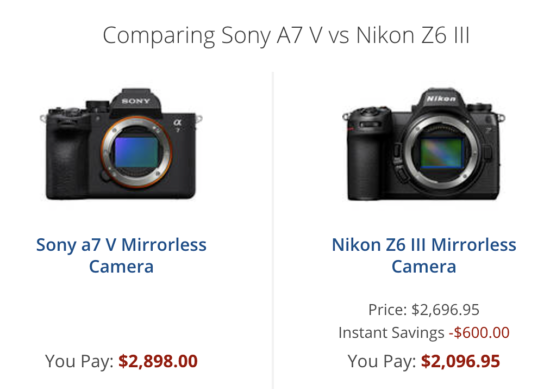
Last week, Sony officially announced the long-rumored Sony a7 V camera, priced at $2,900. Here is a quick AI comparison with the almost 2-year-old Nikon Z6III model ($2,100) – check also the detailed specifications comparison here:
The Sony α7 V (released December 2025) and Nikon Z6III (released June 2024) are both full-frame mirrorless hybrid cameras aimed at enthusiasts and professionals who need strong performance in photography, video, and low-light conditions. The Sony emphasizes higher resolution and AI-driven autofocus for detailed stills and versatile shooting, while the Nikon prioritizes speed, video flexibility, and a brighter viewfinder. Both feature partially stacked sensors for faster readout speeds, reducing rolling shutter distortion. The Sony edges out in resolution and battery life, but the Nikon offers better value and superior video specs. Prices are similar at launch (Sony ~$2,900 body-only; Nikon ~$2,500), though the Nikon is now discounted.
Key Specifications Comparison
| Feature | Sony α7 V | Nikon Z6III |
|---|---|---|
| Sensor | 33MP full-frame partially stacked BSI CMOS (35.9 x 23.9mm), 16 stops dynamic range | 24.5MP full-frame partially stacked BSI CMOS (35.9 x 23.9mm) |
| Processor | Bionz XR2 with integrated AI unit | Expeed 7 |
| ISO Range (Native) | 100-51,200 (expandable to 50-204,800) | 100-64,000 (expandable to 50-204,800) |
| Image Stabilization | 5-axis IBIS, up to 7.5 stops | 5-axis IBIS, up to 8 stops (with Synchro VR) |
| Autofocus | 759 phase-detection points (94% coverage), AI real-time recognition (humans, animals, birds, vehicles, insects), -4 EV low-light | 299 phase-detection points, AI subject detection (9 types: people, animals, birds, vehicles, etc.), -10 EV low-light |
| Burst Shooting | Up to 30 fps blackout-free electronic (full AF/AE), 10 fps mechanical | Up to 20 fps RAW/60 fps JPEG electronic (full AF/AE), 14 fps mechanical |
| Viewfinder | 3.69M-dot OLED, 0.78x magnification, 120 fps refresh | 5.76M-dot OLED, 0.8x magnification, 4000 nits brightness |
| LCD | 3.2″ 2.1M-dot fully articulating touchscreen | 3.2″ 2.1M-dot 4-axis tilting touchscreen |
| Video | 4K 60p (full sensor), 4K 120p (1.5x crop), 10-bit 4:2:2, no RAW; Full HD 120p | 6K 60p N-RAW/ProRes RAW internal, 4K 120p (full sensor), Full HD 240p; 12-bit RAW |
| Storage | 1x CFexpress Type A/UHS-II SD, 1x UHS-II SD | 1x CFexpress Type B, 1x UHS-II SD |
| Battery Life (CIPA) | 630 shots (EVF), NP-FZ100 | 390 shots (EVF), EN-EL15c |
| Build & Weather Sealing | Magnesium alloy, dust/moisture sealed; 695g body-only | Magnesium alloy, dust/moisture sealed; 760g body-only |
| Price (Body-Only, MSRP) | $2,900 | $2,100 |
Image Quality and Sensor Performance
- Resolution and Detail: The Sony’s 33MP sensor provides ~37% more pixels than the Nikon’s 24.5MP, making it better for cropping, large prints, or landscapes where fine details matter. Both deliver excellent dynamic range (Sony ~16 stops; Nikon ~14 stops), but the Sony’s higher resolution gives it a slight edge in post-processing flexibility.
- Low-Light and Noise: The Nikon performs marginally better in extreme low light due to its larger pixels and -10 EV AF sensitivity (vs. Sony’s -4 EV), producing cleaner high-ISO images up to ~25,600. Both handle noise well, but Nikon’s colors are often praised for a more natural “film-like” rendering.
- Stabilization: Nikon’s 8-stop IBIS slightly outperforms Sony’s 7.5 stops, especially with telephoto lenses, thanks to Synchro VR (lens-body sync).
Autofocus and Speed
- Both use AI for subject detection (e.g., eyes, animals), but Sony’s system is more refined for erratic subjects like birds or insects, with 30-50% faster recognition than its predecessor. Nikon’s excels in very dim conditions and sports tracking, borrowing tech from the flagship Z9.
- For action: Nikon’s 20 fps RAW bursts suit wildlife/sports, while Sony’s 30 fps JPEG (with pre-capture buffering) is ideal for silent, blackout-free shooting at events.
Video Capabilities
- The Nikon is the clear video winner, with internal 6K 60p RAW (N-RAW/ProRes) for pro workflows, uncropped 4K 120p, and 240 fps slow-motion—perfect for filmmakers. It also supports RED LUTs for cinematic looks.
- Sony offers solid 4K 60p (10-bit) and cropped 120p, but lacks RAW and overheats faster in long takes without a fan. It’s better for hybrid shooters prioritizing stills.
Build, Handling, and Ergonomics
- Both are weather-sealed and robust, but the Nikon feels more premium with its deeper grip and customizable controls—many users prefer it for all-day comfort. Sony’s compact design suits travel.
- Viewfinder: Nikon’s 5.76M-dot, 4000-nit panel is brighter and sharper for outdoor use; Sony’s is adequate but lags in resolution and sunlight visibility.
- Battery: Sony’s doubles the Nikon’s rated life, a big plus for extended shoots (though real-world use varies with power-hungry features).
Lens Ecosystem
- Sony’s E-mount has a massive advantage: 300+ native lenses, including affordable third-party options (e.g., Sigma, Tamron) for every focal length.
- Nikon’s Z-mount is growing (40+ natives + 300+ F-mount via adapter) with excellent telephotos (e.g., compact 180-600mm), but fewer budget choices overall.
Price and Value
- At ~$2,500, the Nikon offers better bang-for-buck, especially for video-focused users. The Sony’s $2,900 premium justifies the resolution and AF if you’re in the E-mount ecosystem.
Sony a7 V camera officially announced together with a new FE 28-70mm f/3.5-5.6 OSS II kit lens