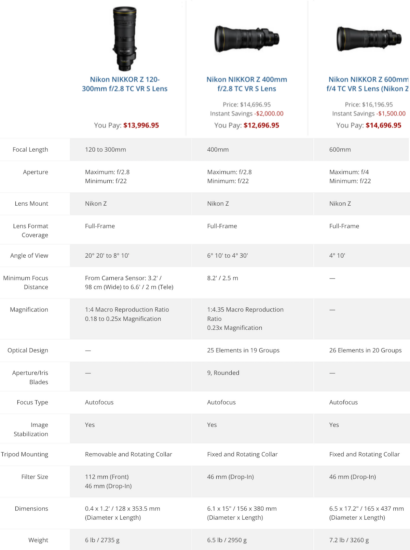
Comparing the new Nikon NIKKOR Z 120-300mm f/2.8 TC VR S lens with the 400mm f/2.8 TC VR S and 600mm f/4 TC VR S:
| Specification | 120-300mm f/2.8 | 400mm f/2.8 | 600mm f/4 |
|---|---|---|---|
| Lens type | Pro zoom | Pro prime | Pro prime |
| Focal length | 120–300mm | 400mm | 600mm |
| With built-in TC | 168–420mm | 560mm | 840mm |
| Built-in teleconverter | 1.4× | 1.4× | 1.4× |
| Maximum aperture | f/2.8 | f/2.8 | f/4 |
| Maximum aperture with TC | f/4 | f/4 | f/5.6 |
| Minimum aperture | f/22 (no TC) / f/32 (with TC) 400: f/22 (no TC) / f/32 (with TC) 600: f/32 (no TC) f/45 (with TC) | f/22 | f/22 |
| Lens elements/groups | 30 / 24 | 25 / 19 | 26 / 20 |
| Special optical elements | 3 ED, 1 Super ED, 2 fluorite, 2 SR, 1 HRI (High Refractive Index) element | 2 ED, 1 Super ED, 2 fluorite, 1 SR | 3 ED, 1 Super ED, 2 fluorite, 2 SR |
| Autofocus | Silky Swift VCM | Silky Swift VCM | Silky Swift VCM |
| Image stabilization | up to 6.5 stops with compatible Synchro VR system | up to 5.5 stops | 5.0 stops (CIPA); up to ~5.5 stops with Synchro VR on compatible bodies (e.g. Z9) |
| Minimum focus distance | 0.98m at 120mm to 2.0m at 300mm | 2.5m | 4.3m |
| Maximum reproduction ratio | 0.18× (at 150 mm, no TC) 0.25× (at 210 mm, with TC) | 0.17× / 0.23× with TC | 0.14× / 0.20× with TC |
| Diaphragm blades | 9 | 9 | 9 |
| Filter system | 112mm front screw-in + 46mm rear slip-in | 46mm rear slip-in | 46mm rear slip-in |
| Dimensions (diameter × length) | 128 × 353.5mm | 156 × 380mm | 165 × 437mm |
| Weight | 2,735g (6.03 lb) | 2,950g (6.50 lb) | 3,260g (7.19 lb) |
| Internal focusing | Yes | Yes | Yes |
| Internal zoom | Yes | N/A | N/A |
| S-Line | Yes | Yes | Yes |
| Price | $13,996.95 | $12,696.95 | $14,696.95 |
Key differences
- 120-300mm f/2.8 TC VR S: The most versatile option. Its 120–420mm effective range with the built-in teleconverter makes it particularly useful for sports where subject distance changes quickly. It is also the lightest of the three. Nikon states it delivers up to 6.5 stops of VR with a compatible Synchro VR camera system.
- 400mm f/2.8 TC VR S: The best compromise between speed and reach. It provides 400mm f/2.8 for maximum low-light performance, with an instant switch to 560mm f/4.
- 600mm f/4 TC VR S: The reach specialist, offering 600mm f/4 or 840mm f/5.6 without adding an external teleconverter. It is the largest and heaviest lens here but provides the greatest native reach.
In simple terms: the 120-300mm prioritizes flexibility, the 400mm f/2.8 prioritizes a balance of speed and reach, and the 600mm f/4 is the choice when maximum reach is the priority.
 <