
Dariusz Breś (Instagram | Facebook | Flickr) tested the Sigma 300-600mm f/4 DG OS Sports lens for Sony E-mount on the Nikon Z9 with the Megadap Pro adapter (see also his previous posts – the full version of this review can be found here:
Sigma 300-600mm f/4 DG OS Sports lens for Sony E-mount tested on the Nikon Z9 camera
Entry
I was one of the lucky ones who received my copy right after the sales launch , even though it was postponed several times. I believe the delays were due to the need to ramp up production, re-arrange the line, and the overwhelming demand for this model. Keep in mind that Sigma is a small, family-owned company, and it’s impossible to produce all its lenses simultaneously.

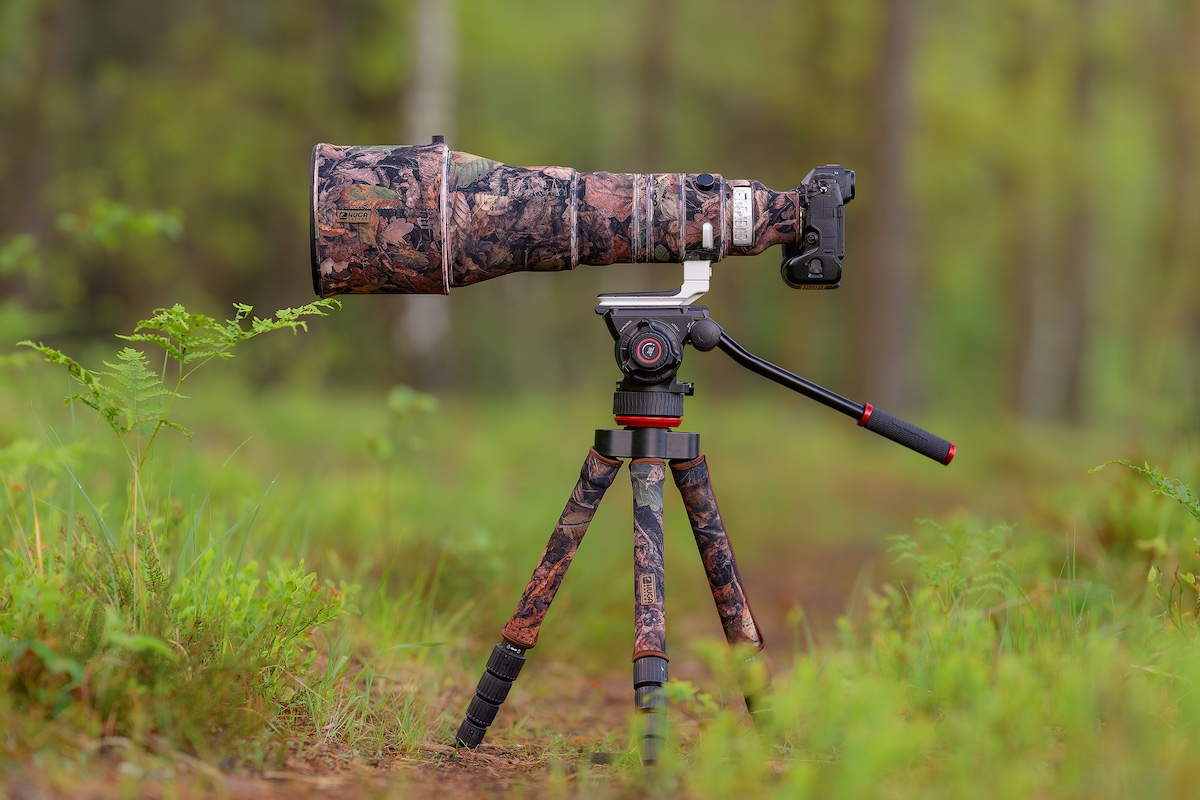
So I had to be a patient. But as soon as I received the lens, the past immediately ceased to matter 🙂 As you can see, the lens is already camouflaged. This makes it look a bit less appealing, but I’m not going to be running around the forest with such a conspicuous piece of equipment 🙂
Sharpness
This lens is sharp throughout the entire focal range . Technology has advanced so much that the Sigma 300-600 4 is sharper than some primes, like the Sony 600 4 GM or the Nikkor Z 400 4.5. Just look at the full frame and the subject at the edge of the frame.

What accounts for this sharpness? Mainly because the Sigma is a newer design, designed for high resolution (45MP-60MP and higher sensors). It utilizes modern low-dispersion glass (FLD, SLD), aspherical elements, and advanced anti-reflective coatings that effectively reduce aberrations, flare, and “milky” appearance. By precisely correcting field curvature, astigmatism and coma, the lens maintains sharpness from the center to the edges of the frame, acting like a prime.


In short: it’s a much newer design, uses modern design tools and high-quality glass, and was designed without compromise for maximum resolution. It’s also worth remembering that optics—like everything—age over time, and the 600 GM is glass from 2019. I’ve added a RAW set at the bottom so everyone can form their own opinion, there’s no denying that.

Plasticity
Geez, country. I absolutely love the plasticity of this lens . F/4 at supertelephoto makes a huge difference. Thanks to the modern optical design, low-dispersion lenses, and aspherical elements – of course, they don’t create plasticity per se, but they enhance its aesthetics, eliminating aberrations and color fringing, making out-of-focus areas more pleasing to the eye.
The designer himself deserves a raise and a barrel of sake , but for now he’ll have to make do with arigatō gozaimasu! By the way, I’d love to meet this craftsman. Thanks to the combination of a telephoto perspective and the f/4 aperture, photos gain a three-dimensional character, and every detail of the main subject remains clear and pleasing to the eye. There’s no aggressive bokeh.
And no, there’s no artificially blurred background in LR/Photoshop, like so many wildlife photos these days . It’s 100% glass bokeh. These files are very pleasant to process. They’re soft, sculptural, with a sharp main subject. Typical of telephoto primes in the 500/4 and 600/4 class.


Speed and Accuracy
And what do you think, Dear Reader, that the Sigma 300-600 4 can capture it even on a camera not designed for it – namely the Nikon Z9, and with the Megadap Pro+ adapter? Such a feat has never been seen in any movie… until now 🙂

I’m impressed with its speed – even though I use an adapter, it still packs a punch, and there’s nothing to be ashamed of. And what about accuracy? I’ve used a lot of lenses and cameras from various brands, and I’ll tell you this: in most situations, I was responsible for blurry photos . Either I was in bad conditions, meaning the thermal conditions prevented a sharp photo, or I had the wrong AF mode selected.
For example, on the Soniacz A1 II I was able to reproduce a flying bird against the forest background – if I had chosen object tracking, it would probably have been different, but since I chose bird detection, the result was what it was.

There’s no system that’s 100% accurate – don’t kid yourselves and don’t argue about it online . There are too many factors that affect AF performance. The same setup can be accurate and yet completely off-target if conditions are unfavorable – for example, when a heat wave passes in front of the lens and the entire sequence is ruined.
The 300-600 on the Z9 also sometimes misses, as do other native lenses , although I think the Nikkor 24-70 2.8 S misses more often – it’s probably the most inaccurate lens on the Nikon :). So if I were to compare the accuracy of the 300-600 against native Z lenses, I would rank it higher than the Z 24-70 2.8 S and lower than the 600 TC. Of course, this is based on my experience, which may differ from yours.

I stopped worrying about accuracy a long time ago, because it’s a level far superior to what D5-class SLRs offered . Oh my goodness, that was seriously off-target – if not BF, then FF… I’m looking through my old photos now and I’m shocked: a third of the photos from the event are blurry, and I gave that to a client? Yeah! I won’t show you those photos, it’s embarrassing as hell.
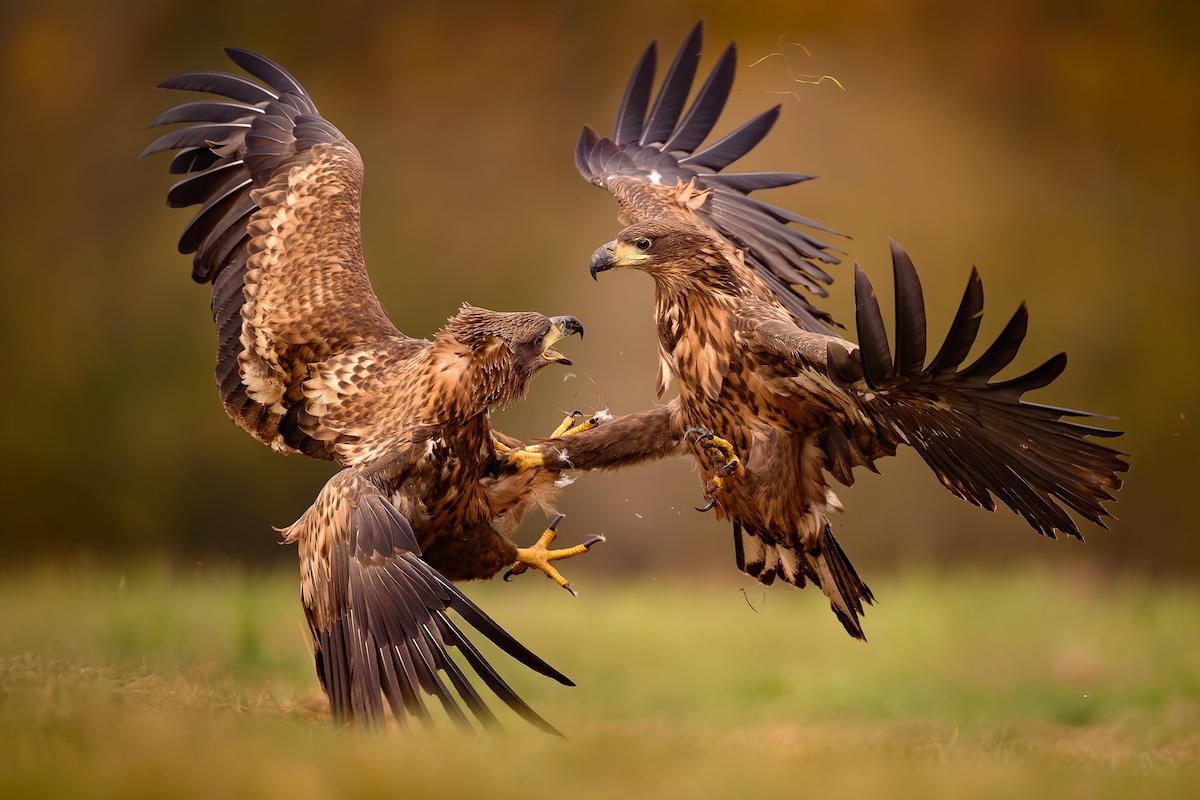
I’ll show you a series of drapol landings. All spot-on shots on the Z9 + Sigma 300-600 4.

Range
The 300-600mm range on its own isn’t particularly impressive compared to, say, the 60-600mm. However, when combined with a constant f/4 aperture, it completely changes the rules of the game and becomes truly impressive . It allows for seamless transitions from long telephoto to extreme supertelephoto without having to change equipment, which is crucial for dynamic and unpredictable scenes.

The constant f/4 aperture provides good depth of field control and high image quality even in low light, and also facilitates working with faster shutter speeds. This range makes the lens a highly versatile tool for professionals who need reach and flexibility in the field. While someone is connecting the TC to reach the subject, I will turn the zoom ring and take 100 photos.
Filming
As you know, the Sigma 300-600 doesn’t have a focus-while-zooming function. I miss this option a bit in the video. However, there’s a workaround – simply don’t activate AF while zooming :). That is, set AF-C or AF-S on the subject, release the AF button, and zoom. Of course, this only works on subjects that aren’t moving forward or backward.
Below are a few videos from 300-600.
Libra
Yes, yes, the 300-600 f4 is heavy . So what? Well, if you’re a weakling or a 70-year-old grandpa, this isn’t the lens for you—unless you’re dragging it around in a cart. But if you’re in your prime, you’ll be fine. “Couldn’t they have made a lighter lens?” someone might ask. Sure, they could, but then you’d all be complaining about the blurriness, the massive vignette, and the low light, because f/5.6. Yes, you’d have lighter glass, but at what cost? All that meat would be wasted.

A monopod or tripod with a head will come in handy . There’s nothing to be ashamed of – this is standard practice with super-telephoto lenses. I’m currently using a Gitzo GM4552L monopod for quicker location changes, or, if I’m in a rush, a tripod with a Nitrotech 612 head, which has a smooth counterbalance, which is incredibly important for filming – when you tilt the rig, it doesn’t fall down; it stays where you set it.


To carry my Sigma 300-600, I use the shoulder strap that’s permanently attached to it. Sometimes I also use the included backpack. I just wish Sigma had it taller to accommodate the lens attached to the body. Damn, that extra 5cm really wouldn’t have saved me any money, but it would have been a huge help when carrying the kit. It’s a bit of a bummer.
Megadap Pro+

The older version could sometimes lock up due to loose contacts, requiring a camera restart . I haven’t noticed this problem with the new model so far. The whole thing works really well now – the mount is tight and precise, and I honestly prefer it to the FTZ. Besides, I’ve finally gotten rid of the FTZ and am done with the world of DSLRs. Below is a comparison of the Megadap Pro+ and Megadap Pro.
I recommend using Megadap with faster cans: Z9, Z8, Z6III, Zf, Zr. In Z6II and Z7II class cans, AF is too slow.
You can download the Megadap firmware upgrade from their website. It’s updated just like a Nikon lens or camera’s firmware, from the box.
Cooperation with a teleconverter
The Sigma 300-600 4 DG OS Sports doesn’t work with Sony teleconverters on Sony cameras due to licensing restrictions. However, you can work around this by connecting the lens to the Nikon Z system using the Megadap Pro+ adapter. As you can see below, there’s no problem.

Megadap Pro and Pro+ work with Sony teleconverters with firmware version 2.02 , but with some limitations regarding the display of information and EXIF data. Aperture and focal length are not displayed correctly.
For example, with a 2x teleconverter attached, the maximum aperture should be f/8 (f/4 × 2), but the display shows f/4. similarly, with a 1.4x teleconverter, f/4 is still displayed instead of f/5.6. Where are the downsides? Someone might say: f/4 at 1200mm is fantastic :). Well, that’s not the case – of course, changing the aperture works and we can set it as we please.


When it comes to the autofocus itself, eye and object detection , and the physical extension of the focal range, everything works properly – the teleconverters function flawlessly . Furthermore, image quality and sharpness remain at a decent level, as can be seen in the attached photos. Whether such a solution makes sense is another question, considering the lens itself offers a very versatile focal range, and there’s often no time to attach a teleconverter. In any case, it works.
Below Sigma 300-600 4 + Sony TC1.4.

Drop-in filters
The Sigma 300-600 4 is equipped with a drop-in filter mount. I purchased an adjustable ND filter with a range of 1 to 7 stops, the Sigma Variable ND RND-21SE. The filter is housed in a special cartridge that inserts into a dedicated slot in the lens – the entire process takes only a few seconds. The dial for adjusting the darkening level is located directly on the cartridge.

An ND filter allows you to slow down your shutter speed without having to stop down . It’s great for both panning and video.
Why slow down your shutter speed? To capture “motion” in your photo—to make the wheels appear to be spinning. This creates a truly dynamic action shot. If you were to slow down the shutter speed, the wheels would be “frozen” in the frame, and the vehicle would appear to be stationary in the middle of the track, rather than racing. Of course, we can reduce the aperture and give, for example, f/12, but we start to catch crap on the matrix, diffraction (depending on the glass) and change the plasticity.

The filter itself works perfectly. If the sun gets too hot, simply increase the gradation using the knob on the housing. Below are photos from the 300-600 at f/4 with the Sigma ND filter in question.


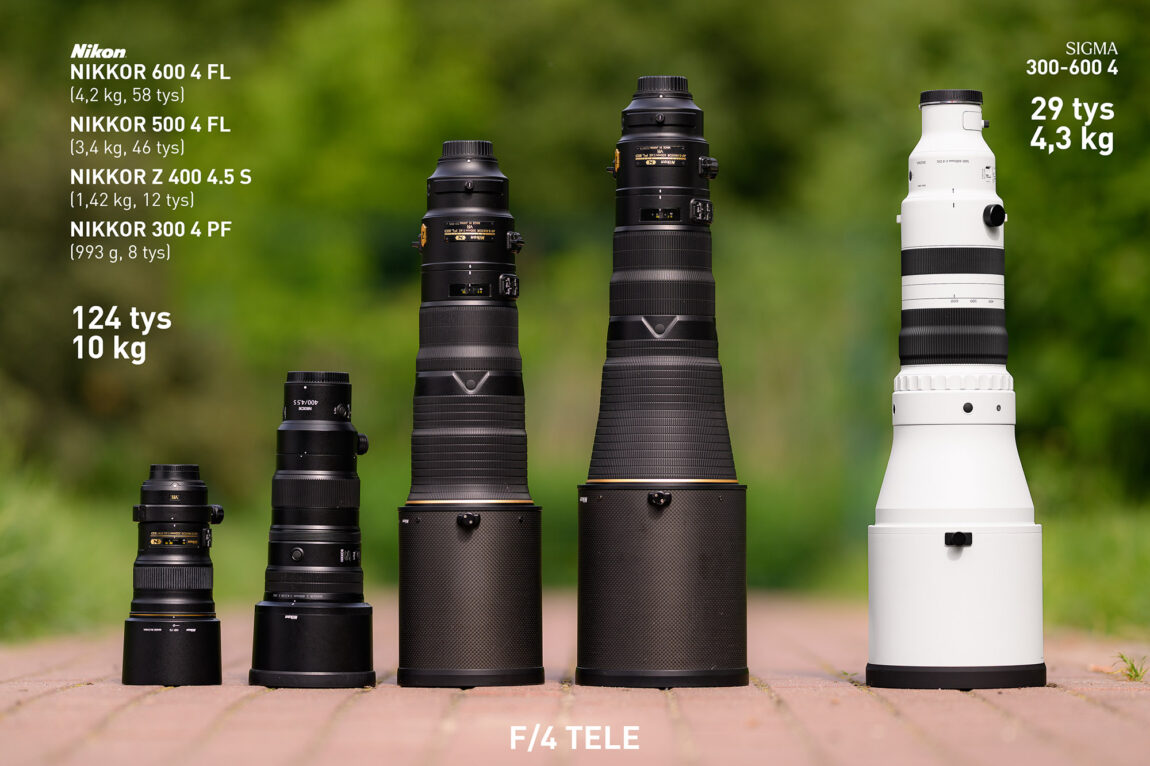
Comparison with other f/4 telephotos
Useful settings
Here I’ll describe a few useful settings when working with the 300-600 lens and the Nikon Z camera . First of all, you need to choose which image stabilization you want to use: the in-lens one or the in-camera one. Enabling both the lens and body stabilization at the same time can cause them to “compete” with each other, resulting in image shake . For obvious reasons, this set does not support the Synchro VR function. So, simply turn off one of them . Personally, I turn off the in-camera stabilization and use the in-lens one, as it’s more effective. Additionally, by switching the Custom switch to the C1 position, the image becomes even more stable.

It’s also worth using an autofocus limiter . For example, if you’re in a spot and know the distance to your subjects in advance, you can easily set the limiter to 10 meters. This further speeds up AF because it doesn’t have to travel the entire range. The same applies when we photograph objects further than 10 meters – then we set the range from 10 meters to infinity.

There’s also a very cool feature: Power Focus – a large dial just behind the zoom ring. It allows you to control the AF motor smoothly or quickly, and also switch the mode to jump to a saved focus point. This is especially useful when you need to “push through” bushes or other obstacles – for example, when a bird is perched in a thicket and the autofocus stubbornly grabs onto branches. Then, you grab the ring and slowly turn it (the increment is small), and the focus plane shifts smoothly, similar to manual focus, except here you don’t have to endlessly turn the ring.


When you switch to “preset,” the lens will immediately jump to the previously set distance. A feature familiar from Nikon telephoto lenses.
Use
I’ve used the Sigma 300-600 for wildlife and sports photography quite a bit . I have to admit that its greatest strength is its zoom range at a constant f/4 aperture. There were many occasions when a subject was approaching and then receding – a quick turn of the ring was enough to get the right shot. In the photos below, Klępa, or a female moose, is shown. I started shooting at 600mm, and as she moved, I gradually reduced the focal length to 500mm, then 400mm. When she got close enough, I went back to 600mm to capture a close-up headshot.


During an American football game, this focal range is a real lifesaver – it allows you to cover practically the entire field. The versatility of the zoom makes work much easier, as I don’t have to constantly change my position. I can simply sit comfortably on the sidelines and freely operate the focal range, adapting the frame to the situation on the field.


Of course, there are lenses with even better ranges, such as 60-600 or 180-600, but they have a fundamental drawback: the aperture of f/6.3. To freeze the movement of, say, a player, you need 1/2500 or less. At f/6.3, on a cloudy day, I’d need a minimum of ISO 6400. On a high-resolution sensor, you’ll start to see significant noise and loss of detail compared to ISO 800 at f/4 – not to mention significantly poorer subject-to-background separation.
This is also the advantage of clear lenses .
Below is a kingfisher, to freeze the movement of such a little one you need at least 1/4000, if you have a cloudy day and an aperture of 6.3 we go to the range of 12 thousand ISO and above.


Summary
This is my main lens for sports and wildlife . The f/4 aperture, at this range, beats everything I know. It allows for a lot and gives a lot. It’s at such a level that the only weak link is you, dear photographer – yes, I’m writing about you and myself. You can’t complain about sharpness, slowness, lack of range, or vignetting. If you’re spitting out crappy shots with this lens, it’s your own fault. Better get to work and learn some knowledge before you start complaining about your equipment.

For me, this glass is NUMBER ONE in Sigma , second is Sigma 200 2 Sports, and in third place is 135 1.4 Art. For years, Sigma has accustomed us to high-quality glasses, but 300-600 is simply a masterpiece.
I’d like a 120-300 2.8 to go with it, and we can conquer the world 🙂 I wrote the one below. PS Thanks to Kucharz for this photo – taken with the new Sigma 200 2 Sports by Megadap Pro on a Z9, another crazy one…
RAW
Since it’s pointless to share high-resolution JPG files, as they’re enhanced by the camera, I’m sharing the RAW files so everyone can judge the sharpness of the lens for themselves. The photos were taken with a Nikon Z9.
Sigma 300-400 4 DG OS Sports RAW Pack
If you have an interesting idea for a guest post, contact me here.