• The new Nikon 300 f/2.8 VRII and the TC-20E teleconverter now available for pre-order

More Nikon patents – hint for a mirrorless Nikon camera?

Nikon filed a bunch of patents at the end of 2008 – here is the patent search result of Nikon + lens. Please note that most of those are just patent applications and may or may not lead to a final production model.

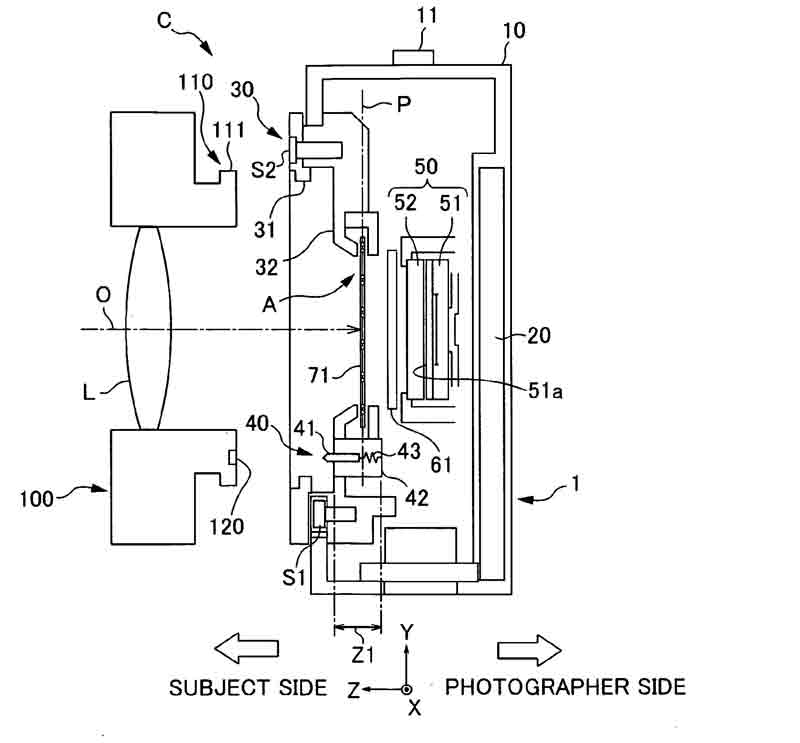
  • Creativemayhem spotted another patent (20090154915) that will cover the lens mount while the lens is removed (Note that the camera on the figure below is mirrorless!):

“Heretofore, lens-interchangeable type cameras provided with a barrier that, in a state in which an interchangeable lens is not attached, closes off an aperture that is provided in a casing for allowing the passage of object light has been known.”
nikon patent More Nikon patents   hint for a mirrorless Nikon camera?

  • Patent 20090167927 – Image sensor, focus detection device, focus adjustment device and image-capturing apparatus:

“It’s a patent for having auto focus pixels on a sensor. They have suggested that we can have some rows on the sensor of a camera dedicated to auto-focus. The pixel rows on either side of the auto focus pixels will have slightly different sensitivities to make up for the ‘lost’ row of data.”


For previous Nikon patents discussions click here.

Related posts:

  1. It’s a Nikon patents Friday (Nikon mirrorless, interchangeable lens camera)
  2. Nikon patents for this week – Nikon EVIL camera again
  3. Will Dr. EVIL knock on Nikon’s door? (Nikon EVIL camera recap)
  4. More Nikon patents
  5. New Nikon patents – it’s all about the headset

This entry was posted in Nikon EVIL, Nikon Lenses, Nikon Patents and tagged , . Bookmark the permalink. Both comments and trackbacks are currently closed.

60 Comments

  1. Ryan
    Posted August 5, 2009 at 2:47 pm | Permalink

    Why in the hell would they want auto focus pixels? seriously thats stupid if true. All the creativity and freeness of cameras is just coming to an end… i think we all need to go back to manual( okay maybe thats pushing it).. but seriously, that is a waist of resolution and time of P&R.

    • Lawliet
      Posted August 5, 2009 at 3:11 pm | Permalink

      It would allow phase detection AF without having the (sub)mirror in position.
      During video recording or lifeview for example, or for high fps shooting with an electronic shutter…

      • Jon Paul
        Posted August 5, 2009 at 4:36 pm | Permalink

        How do you get phase detection without sending the light through prisms? I guess you could hang the prisms down in front of the sensor on something like a DSLR’s mirror. Oh wait…

        • Posted August 6, 2009 at 12:46 am | Permalink

          In this case, the solution is to design pixels for phase detection that do double duty. The mirror has nothing to do with phase detect. That’s just how slrs incorporate phase detect–with a separate mirror that points to an array of sensors at the bottom of the mirror box.

          • Ernst
            Posted August 6, 2009 at 1:38 am | Permalink

            Huh? You can’t do phase detection with the pixels in the focal plane. Phase detection AF is essentially an electronic rangefinder, which requires an interruption of the optical path.

          • Hein
            Posted August 6, 2009 at 4:08 am | Permalink

            “Phase detection AF is essentially an electronic rangefinder, which requires an interruption of the optical path.” —- That’s what they are designing for.

          • Jon Paul
            Posted August 6, 2009 at 12:46 pm | Permalink

            I’m with Ernst. If there’s a way to do it, I’m not seeing it. That doesn’t mean I don’t hope they can, it just seems impossible.

          • Lawliet
            Posted August 6, 2009 at 10:38 pm | Permalink

            Its not a rangefinder, its a split screen.
            Those where always in the focal plane.
            You need two optical pathes, but they are completly symmetrical (systematic misfocus due to lens decentering is a result of violating this), so you just use the lens. You only(manufactoring nightmare) need to replace the ground glass/microlens with a flat piece of glass at the right angle and the size of the microlens to change a image sensel to an AF one.
            Thats where the difference to the rangefinder lies. Rangefinder is a nice analogy to explain how phase AF works by overlaying images, but here it breaks down.

        • Lawliet
          Posted August 6, 2009 at 7:14 am | Permalink

          Or you could use a directional substitute for microlenses. Remember the split screen focus aid – it works by displaying only rays from certain parts of the lens. Such a ground glass also could be used for focusing if you flip the mirror assembly away and place it where the film should be. Now if you interlace such a structure with actual picture generating sensels, you could take measurements while recording a picture.
          Ok, technically they also would be hanging in front of the sensor (but still behind the AA-filter, guess the average photographer couldn’t tell the difference…).

          • Jon Paul
            Posted August 7, 2009 at 12:26 pm | Permalink

            Isn’t the AA filter usually very close to the focal plane, though? How do you put something between that and the AF pixels?

    • fotomik
      Posted August 5, 2009 at 3:25 pm | Permalink

      Why?
      Take a look at the Olympus EP-1, and it’s AF. Or the liveview-AF speed of any DSLR, apart from the few Sony Alphas.
      That’s why. So you can get a DSLR-size chip to AF faster and more accurately. So we can, at some point, have that EVIL-camera that people have been hankering for, in proper Nikon-quality.

      Thank heavens for this.

  2. LGFelix
    Posted August 5, 2009 at 2:58 pm | Permalink

    Interesting. I suspect that there are many improvements that are possible if sensor designers incorporate optimizing functions directly into a detector. For example, imagine a sensor that in addition to providing an auto-focusing (and other) functionality, would go further, actually into coupling the response of a detector on a sectional (ultimately on a per pixel) basis to the local intensity of illumination to provide the greatest response that is possible within the bounds of inherent noise and spectral sensitivity. Of course, it all depends on computing power and I imagine such functionality would first appear as separate software for post processing, then move to on-camera but post-picture, and ultimately to an interactive system that would also optimize each picture for lens response. Then again, who would want a camera with a processor heat sink larger than the lens? We can dream.

  3. NikoDoby
    Posted August 5, 2009 at 3:08 pm | Permalink

    If they build it we will come! Does the patent say anything about a projector?

    • Astrophotographer
      Posted August 5, 2009 at 3:19 pm | Permalink

      That was 20080212957, Camera with built-in projector and projector device.

      • Posted August 5, 2009 at 3:50 pm | Permalink

        Aha! So patents do get filed before the product is released. I got eaten alive once here on this blog and the verdict form the gods was that there was not reason to post patents here on NR because they are filed after a product is released.

        Thanks for the all links Astrophotographer!

        I just don’t know why Google Patents are not updated yet (this is where I follow all Nikon patents)

        • Mikael Willberg
          Posted August 5, 2009 at 4:50 pm | Permalink

          Heh, everything starts from patents. When product idea is tossed around and something comes up, the first thing is to find out if someone already has a patent for it. If it could be used by rivals and if that is significant eanough: patent it. If there already is a patent, is it possible to circumvent the patent somehow and last try to make a deal with the owner of the patent.

          Most often companies make deals with these: “You can use our patents 1+2+3 if we can use 5+6 from your patent portfolio”. Some companies are even aquired because of their patent portfolio.

          Real life example from Nokia, the prototype phones are kept under NDA and they must be bagged if they are taken outside the lab. After all patents have been filed and some other issues are finalized, then the model can be showed to people. I think everyone does this the same way.

          One example that I have heard: all mobile phones can not be powered with a charger if the battery has been removed, that has been patented. If I remember correctly Ericsson owns this one. But this has been circumvented by charging the battery which in turn powers the phone. Most users do not even notice this issue.

          The point is even if a patent license costs a very tiny amount per product, the total cost with the most profitable products (cheap item, but sale volume of millions) is huge.

        • Astrophotographer
          Posted August 5, 2009 at 6:11 pm | Permalink

          Yes, I was burned by google patents too. Looking directly at the USPTO site I found Nikon submitted the 70-200mm in april 09, #20090086321.

          So USPTO is the place to get the latest.

          • Posted August 5, 2009 at 6:51 pm | Permalink

            Thanks Astrophotographer. I will go through all of those patents again, but I think we have some good info here – Nikon filed a bunch of patens and some of them started to come out in the product announcements. I say 24mm 1.4 by the end of the year – with the next FF camera release.
            Yes, it does make absolute sense to file the patent before the release date, so I think we are on the right path. I will start monitoring USPTO. Hopefully Google will fix their patent site.

        • Posted August 6, 2009 at 12:53 am | Permalink

          Patents absolutely get filed before a new idea is implemented, however you often won’t be able to view a patent until at least a year after it has been filed. If you want to see good examples, look at some patents and you’ll see both when they were filed and when they were granted.

          The important date is the filing date.

        • dave
          Posted August 6, 2009 at 6:05 pm | Permalink

          As someone with a number of patents in the computer industry, I can tell you that patents can and do get filed at any point in the game. Patent grants can take any where from one to five years. Once you file, you are protected. But once it goes into a product and the product is released, depending on the scope of the patent, a competitor could claim that since you released the product prior to filing, the invention is now public domain and they can copy. You generally want to file a patent before a product containing the invention is released, but not so far in advance that you telegraph what you are doing to your competitors so that they have time figure out what you are building and make one of their own or even file supplemental patents based on your patent. Filing a patent after the invention is in public domain does not help your chances of getting it granted and can even hurt your chances.

          Patents may also be pre-emtive. Let’s say you come up with 5 different ways to do focusing. You do a patent search to see if any of them are patented already. You then patent the ones that aren’t already patented even if you aren’t going to implement the technology in a product. Why? To prevent your competitors from using those techniques to provide the same function as the one technique you are going to use in your product. You can then license the patent(s) to other companies, or more often, you bundle them with other patnets and trade the right to use your patents for the right to use someone else’s.

  4. Nikkorian
    Posted August 5, 2009 at 3:13 pm | Permalink

    Interesting, the AF-pixel row!!

    It could either mean they provide a special type of pixel row, say with separate thus fast readout to speedup contrast-detect AF.

    Or it means, that an optical device, consisting of a few lenses to allow for triangulation, has to be moved sideways into the lightpath between lens and sensor, just for a short period of time while phase-detect AF measures.

    Cheers,
    Martin

    • Jon Paul
      Posted August 5, 2009 at 4:39 pm | Permalink

      Yeah, the faster contrast-AF idea is plausible, but isn’t the goal to get away from having things dangle in front of the sensor, as you would need for phase-AF?

      • Nikkorian
        Posted August 5, 2009 at 7:59 pm | Permalink

        Speed is vital in AF technology. If they get contrast tech up to phase speeds, this is the way to go.

        • Desinderlase
          Posted August 6, 2009 at 4:56 am | Permalink

          phase detection is contrast type of detection also

          • Nikkorian
            Posted August 6, 2009 at 7:20 am | Permalink

            well, if you measure a pixel-line, as it’s done in phase-detect af, there is, of course, light and darkness on it and thus contrast, but the information is not used as such. contrast detection measures the range of a change from 1 to 0. in phase-detect af, the shift of a maximum (or minimum) intensity is determined. it’s effectively a triangulation.

  5. Posted August 5, 2009 at 3:13 pm | Permalink

    Hmmm…. a micro fourthirds Nikon? a APS-C sized p&s? a digital FM2 equivalent?!?

    • WillyPete
      Posted August 6, 2009 at 8:30 am | Permalink

      No, a digital version of the Nikon Rangefinders.
      Have alook into that subculture and you’ll see MASSIVE amounts of money still changing hands for these items.
      The Nikon SP was released a relatively short while ago and it was ONLY available in Japan and completely sold out.

  6. Pat
    Posted August 5, 2009 at 3:17 pm | Permalink

    so a AF-S 24mm f/1.4G ED N finally? This patent is the first ‘official’ indication of such a lens from Nikon. They can certainly play with a lot of parameters (focal length, aperture) in simulations related to this patent, but filing one with 24/1.4 specified is a good indicator nevertheless.

    Given the $2399 MSRP of 70-200, i would say 24/1.4 MSRP would be $1999.

  7. Crabby
    Posted August 5, 2009 at 3:22 pm | Permalink

    A few months ago, I posted the idea of a mirrorless Nikon on *ikonia*s.o*g and you would think I suggested that the Nikon police come out and rip the mirror out of every D3 and D3x out there by the response I got! I was speaking of a camera between today’s DSLR’s and (moan!) Coolpixes, of course, and that was well before the cute new camera from Olympus hit the market.

    In just a very few years, the omnipresent cell phone will take photos of the quality today’s compact cameras offer up. Some companies will start adding this and that to compact cameras (starting with projectors, I suppose). Others (or even the same company) will work hard to offer better technology to go inside of phones to take better pictures. (Who knows if self-focusing pixels produce a smaller nano-camera, but it may well be the case.) Just like the merger of phones and PDA’s eight or so years ago, there will be winners and losers, but nobody will be able to say if the compact cameras “ate” the phones or vice-versa. My money is on whoever comes up with good stuff to survive the upcoming merger.

  8. Chris
    Posted August 5, 2009 at 3:42 pm | Permalink

    Please keep the mirror! And I don’t want an electronic view finder (would be the logical consequence)!!! I’ve to watch so many hours a day into a monitor, so I don’t want to watch into a monitor more while I’m taking pictures!!!!!! I could imagine living without an mechanic shutter (higher shutter speed in combination with flash) and would be pleased having something between sensor and environment (to avoid better dust and dirt on the sensor), but NOOOOOO electronic view finder. Do such rag in the lowest consumer camera, but not in a camera of the D90 league or higher!

    cp

    • Jon Paul
      Posted August 5, 2009 at 4:46 pm | Permalink

      I’m sure there will always be an alternative to an EVF–this stuff isn’t going to be made to replace the high-end DSLRs.

  9. TC
    Posted August 5, 2009 at 3:48 pm | Permalink

    MR admin, you are on a roll… Looks legit to me. 25mm f1.4 on it’s way soon. The Japanese patent was first submitted in jan 08, so it can’t be far away now. Looks like it should be smaller than the canon version, and optically superior.

    • Posted August 5, 2009 at 6:54 pm | Permalink

      I think so too – the patents for the other products started to show up (they were filed at aprox. the same time). Nikon knows that, so the release should not be far away, at least for the 24mm 1.4.

      • Desinderlase
        Posted August 6, 2009 at 4:58 am | Permalink

        I remeber some rumors about Nikon having many lens designes ready, and they are waiting for the right opportunity

  10. Posted August 5, 2009 at 5:43 pm | Permalink

    this would be so awesome!
    -peter

  11. Adam
    Posted August 5, 2009 at 7:13 pm | Permalink

    As long as DSLR stays with optical viewfinder then I don’t care non-DSLR use EVF to replicate a DSLR VF, but if DSLR did end up with EVF, hello petition form!

    • Jon Paul
      Posted August 5, 2009 at 7:27 pm | Permalink

      You’re not alone, Adam, and that’s why it probably won’t happen. But eventually it might. What if someone came up with an infrared laser rangefinder (or something) that would actually track where your eye was looking in the viewfinder and allow you to have focus that was as fast and accurate as current phase-detected AF without having the mirror down in front of the sensor? If the pixel pitch of the electronic viewfinder was small enough that the human eye couldn’t resolve the pixels, and the shooting speed gain was frame rates in the neighborhood of 10+ frames per second at full resolution, no one would complain. It would make current SLRs look like clumsy. I know–lots of ‘ifs’ in there, but nothing impossible.
      I think it’s better to say that your opposed to switching DSLRs to have EVFs now with current EVF technology. If the technology improves to where the benefits beat out the costs or the costs disappear, there’s no reason to fight it just because you’re used to the old. (see film vs. digital)

      • Jon Paul
        Posted August 5, 2009 at 7:28 pm | Permalink

        Blast! I posted this before filing the patent application!

      • Jon Paul
        Posted August 5, 2009 at 7:30 pm | Permalink

        And I of course meant “you’re opposed” not “your opposed.” Don’t you hate it when people don’t proofread there ;-) own posts?

  12. shivas
    Posted August 5, 2009 at 9:46 pm | Permalink

    patents absolutely have to be filed before a release, or any public disclosure, given IP laws and how much competition is out there. . .

    It’s bitter sweet to see that the 24 1.4 will come true – it’ll probably be minimum $899 to $1299, and will ROCK on a FX body. . .just difficult for me as a semi pro to decide whether to sell off DX, or make this an addition to my collection . . .

  13. Geoff
    Posted August 5, 2009 at 10:00 pm | Permalink

    if the 24 1.4 comes out, does that mean there is no chance of Nikon updating the 24 2.8? What about a sharp wide angle prime for those of us that dont need the 1.4 speed and couldnt afford it even if we did need it?

  14. Blago
    Posted August 6, 2009 at 1:49 am | Permalink

    Then you just go to the dealer and get 24/2.8 ? whats the problem ?

    • Geoff
      Posted August 6, 2009 at 7:54 am | Permalink

      the 24 2.8 isn’t very good. It’s not that sharp and has bad CA

  15. Jeff-c
    Posted August 6, 2009 at 3:23 am | Permalink

    “the plurality of non-imaging pixels are disposed in place of the green pixels and blue pixels that are the some of the plurality of types of imaging pixels”

    It seems they are using the green and blue pixels for the focus pixels.

  16. Jeff-c
    Posted August 6, 2009 at 4:01 am | Permalink

    After reading through the whole patent I should retract my comments above.

    The focusing pixels are placed in positions that are otherwise occupied by green and blue pixels. The patent went on to suggest such placement resulting errors that are not easily visible to human eyes.

  17. Jeff-c
    Posted August 6, 2009 at 4:22 am | Permalink
  18. Posted August 6, 2009 at 7:02 am | Permalink

    Thanks for your blog.

  19. Roger Moore
    Posted August 6, 2009 at 12:05 pm | Permalink

    There are some other interesting goodies in there. The thing that really caught my eye was several variants on a roughly 10.5-108mm zoom. It has enough coverage for a roughly 4/3″ sensor and a very short backfocus distance. That combination makes no sense for a Nikon interchangeable lens camera, but it would be perfect for a relatively large sensor compact.

    • Jon Paul
      Posted August 6, 2009 at 12:50 pm | Permalink

      Good eye, Roger.

      • Roger Moore
        Posted August 6, 2009 at 6:17 pm | Permalink

        Good eye, maybe, but apparently not a good calculator. The lens in question is supposed to have a FOV of roughly 82° to 9°. That corresponds to an image circle of something like 17mm, not the roughly 22mm of the 4/3″ sensor. It’s still larger than any current compact, though.

      • Anonymous
        Posted August 6, 2009 at 7:18 pm | Permalink

        Of course. He’s 007 afterall.

  20. Anonymous
    Posted August 6, 2009 at 1:08 pm | Permalink

    I think it has begun big time here.

  21. Jay A
    Posted August 6, 2009 at 3:32 pm | Permalink

    Impressive posts regarding the interpretations of these patents by previous posters. I assume those posters don’t work at Lens Crafters. :) So should I sell my 28 1.4 for my FX cameras yet?

    • Roger Moore
      Posted August 6, 2009 at 5:06 pm | Permalink

      “So should I sell my 28 1.4 for my FX cameras yet?”

      That depends on how much of a gambler you are. ISTR that a 28/1.4 in good condition can sell for well over $3000, while a new Nikon 24/1.4 is likely to sell for under $2000. If you don’t depend on it too heavily, and you’re willing to take a gamble, you might do well to sell for the premium price now and use the money to buy a 24/1.4 when it comes out. The left over money could pay for quite a bit of other stuff, too.

  22. kuri
    Posted August 6, 2009 at 7:07 pm | Permalink

    So.. this patent for the ‘barrier’ when a lens is not attached on the mirror-less camera, could this be something that automatically seals the body as soon as you unlock the lens, thus preventing dust getting on the sensor?

    Surely it won’t totally eradicate dust, as dust can still be introduced by attaching a lens, but it might help preventing dust on the sensor, especially if there’s no mirror in front?

    Something that would aslo be very nice on a digital -interchangeable lens- rangefinder, btw.

  23. Zograf
    Posted August 6, 2009 at 10:00 pm | Permalink

    Admin,
    The first patent you point to is for 85mm, f/3.6 VR lens, at least all calculated examples are… This could be a specialized lens not aimed at the consumer photography.

    Last year I did a lot of Nikon patent search – Nikon would never make public(or publish) an US patent before the product is out. Usually the patent is published quite a bit later.

    My conclusion is, looking at Nikon’s patents to see what future products (in the consumer photography) would come out is pointless!!

    • Astrophotographer
      Posted August 7, 2009 at 2:23 am | Permalink

      Not necessarily, Patent application 20090086321 publisher 4/2/09 was for a 70-200 f2.8 FX lens. Sounds familiar. The camera/projector is another. Most of the time, from what I’ve checked, Nikon submits the application shortly before product release and the USPTO publishes it a few months later, by which time the product is out. But there are exceptions.
      I looked at the 85mm too. I think that patent is about a new VR with the 85 as just an example. This statement is key:
      “… lens group that can move in a direction substantially vertical to an optical axis”

  24. gurbally
    Posted August 7, 2009 at 2:11 am | Permalink

    When will the 24mmG 1.4 finally see the ligth of the day?

  25. Mark
    Posted August 7, 2009 at 11:44 pm | Permalink

    Well, just look at the market trends, Samsung’s hybrid NX on its way, like an SLR without the mirror so it is more compact, and the Olympus PEN E-P1 is out already and it is a rangefinder style.

    I am hoping Nikon will come out with two camera, the more likely a rangefinder like, semi compact with a DX or FX sensor at a good solid price point.

    The other less likely to happen, a medium format rangefinder, with the right plans it is not impossible for Nikon to sell it for about 9 to 10k (US dollars).

    Any of these cameras I hope Nikon will offer the option the Olympus PEN E-P1 camera has on aspect ratios: 4:3, 3:2, 16:9, 1:1 — I think offering different aspect ratios is a great feature that can easily be offered.