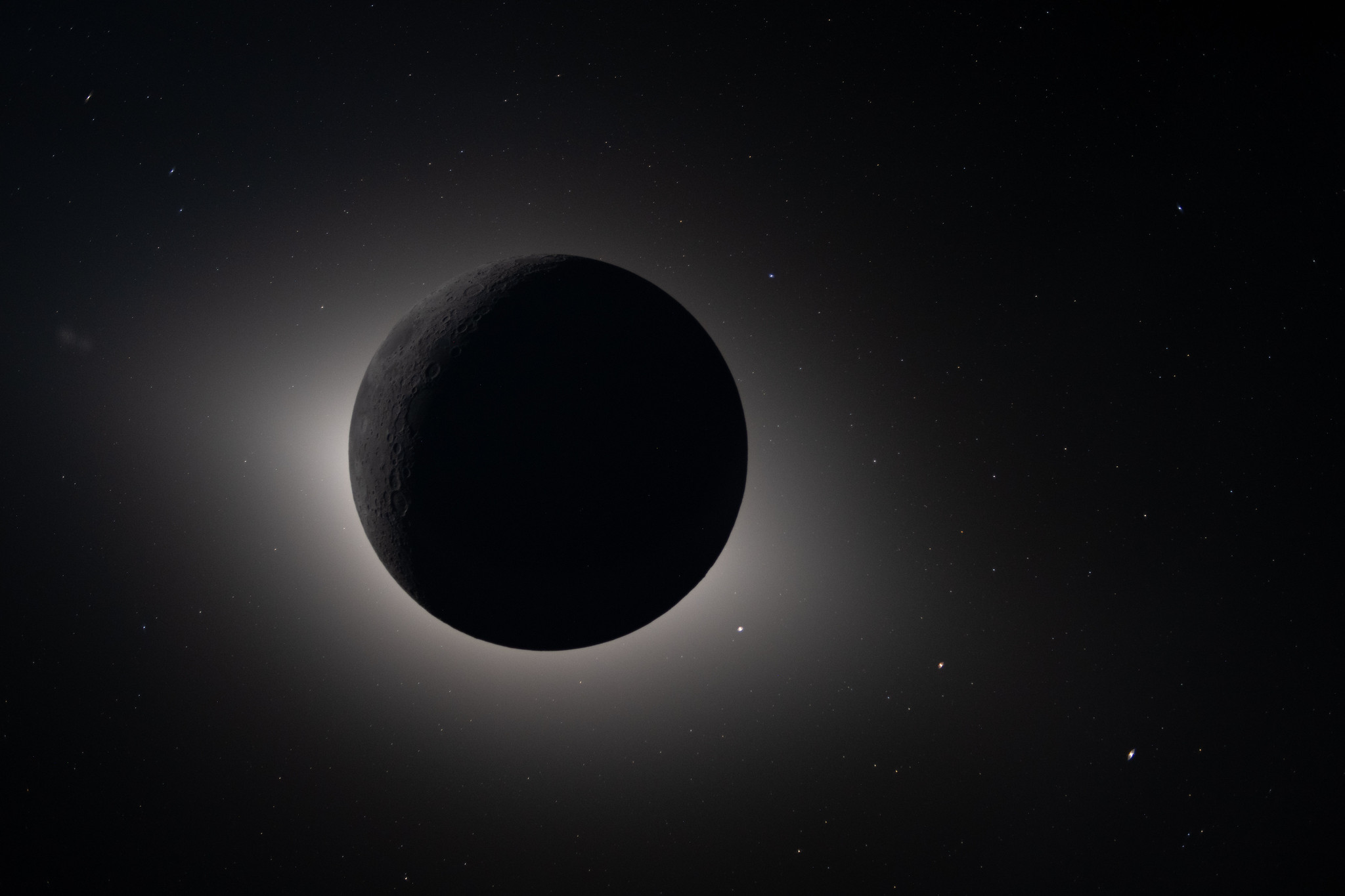
The above Nikon Z9 image from Artemis II enables major scientific discovery: large-scale morphology of the optical F-corona:
Researchers have published a peer-reviewed scientific paper demonstrating that a single publicly released JPEG image taken with a commercially available Nikon Z9 during NASA’s Artemis II lunar flyby has provided valuable new insights into the structure of the optical F-corona (the inner zodiacal light).
The paper, titled “Large-scale Morphology of the Optical F-corona from a Total Solar Eclipse Observation during the Artemis II Lunar Flyby,” was published on June 9, 2026, in The Astrophysical Journal Letters by Kohji Tsumura (Tokyo City University / Tohoku University) and Ko Arimatsu (National Astronomical Observatory of Japan).
The image in question is NASA’s well-known “Artemis II in Eclipse” (NASA ID art002e009301), captured on April 6/7, 2026, during the crew’s lunar flyby at an altitude of approximately 6,545 km above the lunar surface. Camera settings (from image metadata):
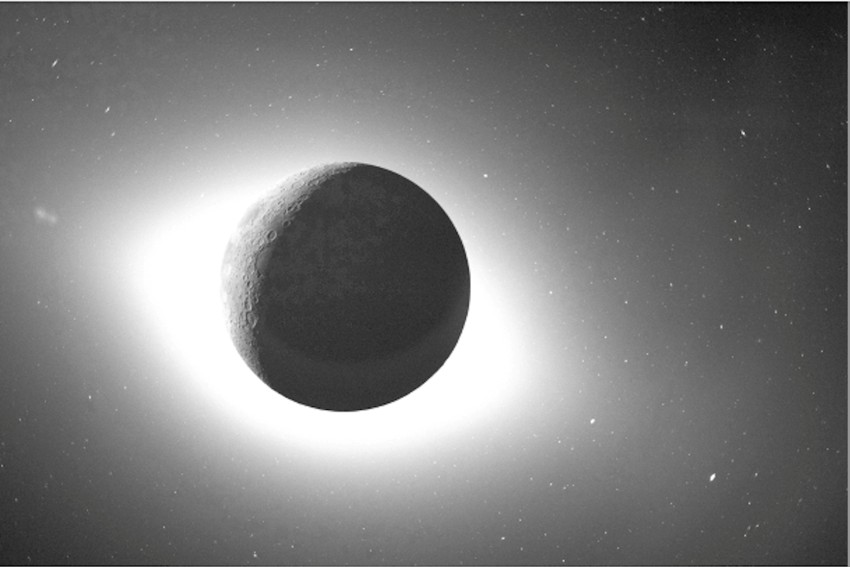
Because the spacecraft was so close to the Moon, the lunar disk appeared much larger than the solar disk (apparent lunar diameter ~16.9°, solar ~0.53°), producing nearly an hour of totality – far longer than any Earth-based total solar eclipse. The Moon completely occulted the Sun, revealing a glowing halo of the F-corona (sunlight scattered by interplanetary dust particles) over a wide ~51° × 33° field of view, along with numerous field stars and even Saturn and Mars.
Although the image is a rendered JPEG without full photometric calibration, the authors carefully accounted for the gamma correction and validated that the camera response was linear in the unsaturated regime using field stars. They performed:
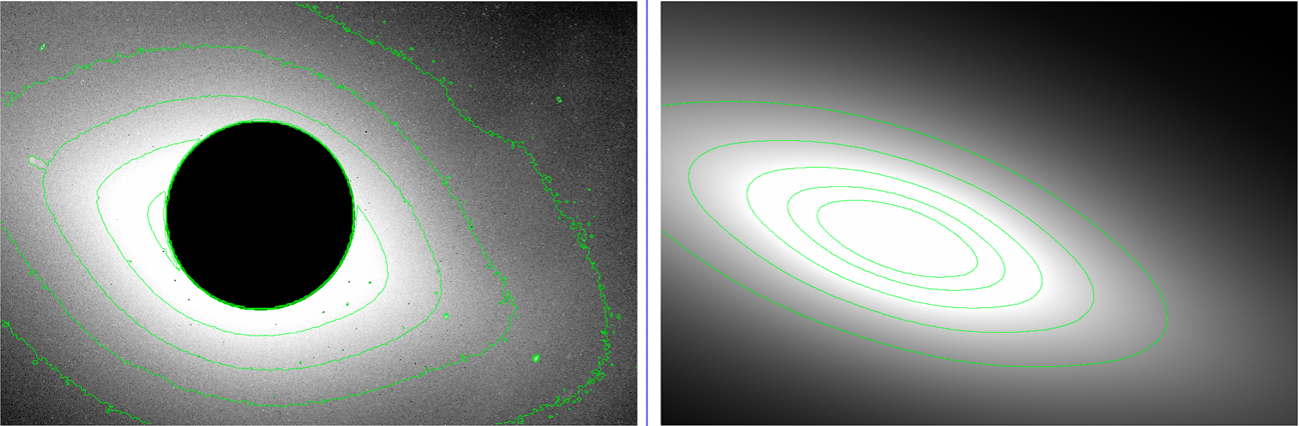
Left: Spread of the F corona as captured by Artemis-II. Right: Spread of the F corona calculated by the model
Here’s what the researchers actually discovered from that one Nikon Z9 photo:
The faint halo of light you see around the dark Moon (the F-corona / zodiacal light) is flattened like a pancake rather than a perfect circle. It is stretched out along the plane of the solar system (the same flat disk where the planets orbit). Think of it like a slightly squished balloon pressed against the ecliptic plane.
This small asymmetry matches what we’d expect from our viewing angle looking at the giant cloud of dust that surrounds the Sun.
The glow gets dimmer the farther you look from the Sun, following a steep “power-law” drop-off. The researchers found it drops off more quickly than older space measurements suggested. This tells us something important about how the dust is distributed: the number of dust particles decreases with distance from the Sun at a rate of roughly α ≈ 1.3.
The bright streamers and plasma you usually see in total eclipses (the K-corona) are basically absent in this image at the distances they measured. What we’re seeing is almost pure sunlight bouncing off tiny interplanetary dust grains.
Even though it was just a normal JPEG from a handheld Nikon Z9 (not a specially calibrated scientific instrument), after careful star-based calibration, the data was good enough to publish in a top astronomy journal. This is the first real “proof of concept” that astronauts flying past the Moon with everyday high-end cameras can gather useful data about the dust cloud that fills our solar system — and that future lunar-orbit missions could do this routinely.
A two-second photo taken with an off-the-shelf Nikon Z9 during Artemis II’s lunar flyby revealed that the dusty glow around the Sun is flattened, slightly lopsided, and falls off more steeply than previously thought – proving that even a regular camera in space can make genuine discoveries about our solar system’s dust cloud.
The authors conclude that the results provide “an empirical proof of concept that supports future solar coronal occultation observations from lunar orbit” and demonstrate that “opportunistic observations from crewed lunar missions can provide valuable insights into the structure of the inner zodiacal cloud.”
Kohji Tsumura (lead author):
“I was amazed to learn that this remarkable image was captured by an astronaut using a commercially available Nikon Z9 with an exposure time of just two seconds—a true testament to how far digital camera technology has come. Although I was initially sceptical about analysing a JPEG image, the quality proved comparable to data used in professional astronomical observations. Astronomy is unique in that amateurs and professionals alike can make meaningful contributions, and as high-performance cameras become more accessible, I believe images taken by amateur photographers will increasingly lead to unexpected scientific discoveries.”
Ko Arimatsu (co-author):
“The findings demonstrate that scientifically valuable data can be extracted from consumer camera images when properly calibrated and analyzed. This suggests that high-performance consumer cameras could serve not only for documentation during future space exploration, but also as tools for unexpected scientific discoveries.”
Hiroyuki Ikegami, Nikon Senior Executive Vice President, General Manager of Imaging Business Group:
“Seeing the images from the Artemis II mission return to Earth is a profound honor for all of us at Nikon. This latest research from Tokyo City University acts as a powerful reminder of what imaging can make possible when science, exploration, unrelenting effort and human curiosity come together.
For more than five decades, from Apollo 15 to the Artemis program, Nikon has been privileged to support NASA with cameras and lenses designed for exceptional clarity and reliability in the most demanding environments. The Nikon Z9’s high resolution, expansive dynamic range and outstanding low-light performance are helping crews capture incredible details.”
Previous NikonRumors coverage of Artemis II:
New photos from the Artemis II mission released, and how NASA is testing cameras for flight
The Nikon Z9 is going to the moon with the upcoming Artemis III mission